


Gold Bull-Bear Battle at $4,000: Precious Metals Sector Rises Against Trend
Bull-Bear Battle at $4,000: Precious Metals Sector Rises Against Trend; How to Interpret Long-Term Logic?
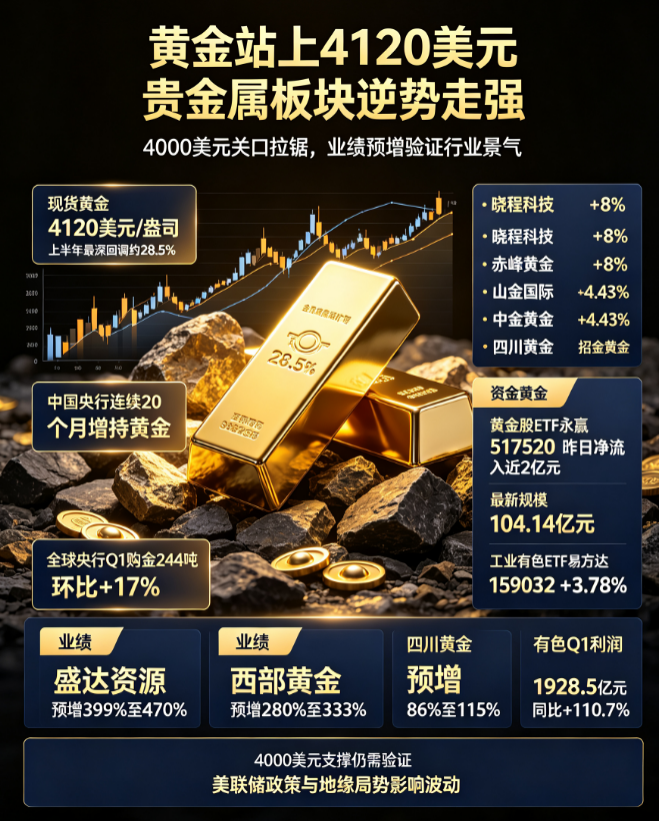
On July 22, 2026, the four major A-share indices opened lower, with market sentiment generally weak. However, the precious metals sector became the brightest spot on the board, surging strongly against the trend. By early trading, spot gold continued to rally, breaking through $4,120 per ounce, reigniting investor enthusiasm for gold assets. Among individual stocks, Xiaocheng Technology (300139) and Chifeng Gold (600988) rose over 8%, followed by Shanjin International, Zhongjin Gold (600489), Sichuan Gold, and Zhaojin Gold. Chifeng Gold rose 6.99% during the session to 37.96 yuan per share, with turnover of 6.28 billion yuan; Zhongjin Gold rose 4.43% to 21.70 yuan per share, with turnover of 4.62 billion yuan and net inflow of main funds of 55.2466 million yuan. In terms of capital flows, the largest gold stock ETF of its kind, Yongying (517520), saw net inflows of nearly 2 billion yuan yesterday, with the latest scale reaching 10.414 billion yuan; the Industrial Nonferrous ETF, Yifangda (159032), also rose 3.78% with active trading.
However, behind this rebound, the precious metals sector experienced a deep correction of nearly 30% in the first half of 2026. Does gold's return above $4,000 represent a valuation repair after an oversold bounce, or a reconfirmation of the long-term uptrend logic? This article will analyze the current dynamics of the gold market from multiple dimensions to help investors clarify their thinking.
1. The Dual Significance of the $4,000 Threshold: Technical Bottom and Psychological Battle
On July 21, spot gold staged a dramatic rebound. The intraday fluctuation range exceeded $80, with the session high near $4,085. It closed up about 1.65% at $4,073.51 per ounce, reclaiming the key psychological threshold of $4,000 and the 50-period and 100-period moving averages. Subsequently, in early trading on July 22, gold prices further rose to $4,120 per ounce, revealing a clear short-term strong pattern.
However, looking back at the first half of the year, gold's performance was brutal. On January 29, international gold prices once surged to a historical high of $5,596 per ounce, but by June 26, gold prices had fallen below $4,000 per ounce, with a maximum decline of 28.5%. On June 30, London gold even dropped to $3,942.43 per ounce, hitting the lowest price for the first half of 2026. From the historical peak to the stage bottom, within just five months, the gold market experienced a rapid shift from frenzy to panic.
The catalyst for this rebound came from subtle changes at the macro level. According to industry analysis, due to recent weak US inflation data, the market's pricing of Fed rate hikes has cooled significantly. The US June CPI rose 3.5% year-on-year, below market expectations of 3.8%, and core CPI also fell short of expectations. The core factor that had previously suppressed precious metal prices—the expectation of continued tightening monetary policy—has seen a phase of relaxation. The market has begun to reprice the Fed's future rate path, thus providing a breathing space for gold.
However, the battle for the $4,000 threshold is far from over. From a technical perspective, although gold prices have stabilized and rebounded after a correction of nearly 30%, the support strength around $4,000 still needs repeated verification. If expectations of Fed rate hikes heat up again, gold prices may come under pressure. Since 1980, gold prices have experienced two deep corrections, and the current market is still divided on whether gold can stay above $4,000. This is a reality that both bulls and bears must face.

2. Central Bank Gold Purchases: The "Ballast Stone" of the Gold Price Rebound
Behind this round of gold price rebound is the sustained, counter-cyclical gold purchasing behavior of global central banks. This has become the most solid bottom support for the gold market.
Data released by the People's Bank of China on July 7 showed that as of the end of June 2026, China's gold reserves stood at 75.44 million ounces (approximately 2,346.45 tons), an increase of 480,000 ounces (about 14.93 tons) from the end of May, marking the largest monthly increase in gold holdings since November 2024. Thus, the People's Bank of China has increased its gold holdings for 20 consecutive months. Moreover, in the first quarter of 2026, global central banks purchased 244 tons of gold, a quarter-on-quarter increase of 17%. The World Gold Council's "2026 Global Central Bank Gold Reserves Survey" released on June 16 showed that nearly 90% of surveyed central banks believe that global central bank gold reserves will continue to increase over the next 12 months; 45% of surveyed reserve managers plan to increase gold holdings in the next year, a record high for this survey.
This sustained, counter-cyclical official demand has gradually become the "ballast stone" and main source of buying for the global gold market. Unlike speculative capital, central bank gold purchases are typically based on long-term strategic considerations, including de-dollarization, portfolio diversification, and hedging geopolitical risks. This means that even if gold prices fluctuate sharply in the short term, the pace of central bank gold purchases will not be easily interrupted.
Liu Yu, Chief Economist at Industrial Securities, pointed out in a research report that gold prices have not yet left the range-bound zone. With the FOMC's hawkish tone likely already largely priced in, the biggest macro uncertainty ahead lies in the development of the US-Iran situation. The escalation of geopolitical risks often boosts gold's safe-haven demand in the short term, but may also backfire on gold prices by triggering inflation and rate hike expectations. This two-way influence makes gold's role in the macro environment more complex.
3. Earnings Support: Precious Metals Sector Leads the Industry
The precious metals sector's rally is not a castle in the air; the earnings of listed companies are validating the industry's prosperity. Recently, over 15 listed mining companies have intensively released first-half performance forecasts, with "higher volume and prices for main products" being a core keyword. The earnings growth of the precious metals sector leads the entire industry, with silver and gold companies showing particularly impressive profitability.
Silver mining company Shengda Resources expects net profit of 350 million to 400 million yuan for the first half, a year-on-year increase of 399.31% to 470.64%. The gold sector also posted strong pre-warnings: Western Gold expects net profit attributable to parent of 500 million to 570 million yuan, up 280.16% to 333.39% year-on-year; Sichuan Gold expects profit of 390 million to 450 million yuan, up 86.94% to 115.7%. Pengxin Resources expects net profit attributable to parent of 220 million to 260 million yuan, up 55.51% to 83.79%.
Driving the surge in mining profits is the overall rise in prices of nonferrous metals such as copper, gold, and silver. The nonferrous metals industry achieved profits of 192.85 billion yuan in Q1 2026, up 110.7% year-on-year. Analysts believe that nonferrous metals, as core strategic metals for the energy transition and digital economy, have not changed their long-term supply-demand mismatch pattern. Leading companies with high-quality proprietary mines and continuous expansion are expected to fully benefit from the long-term high prosperity cycle of the industry.
From the perspective of capital flows, gold stock ETFs continue to receive large net subscriptions, indicating institutional investors' confidence in the sector's outlook. Net inflows of main funds into stocks such as Chifeng Gold and Zhongjin Gold are significant, further confirming positive market sentiment.
4. Outlook: Strengthened Long-Term Logic Amid Short-Term Risks
Multiple institutions have expressed positive views on the precious metals sector's outlook. Huayuan Securities noted that in the long term, the bullish logic for gold has not weakened but has actually strengthened amid changes in the global macro and geopolitical landscape. Continued gold purchases by global central banks still provide solid bottom support for gold prices, and the People's Bank of China's continued holdings further validate long-term allocation demand. Gold remains in a favorable window in the medium to long term, and the price center is expected to continue moving upward during the reshaping of the global macro and geopolitical landscape.
CITIC Securities previously judged that during the Fed's rate-cut cycle, global ETF inflows will continue to boost gold prices upward, while long-term factors supporting gold price increases, such as US debt risks and the de-dollarization trend, have not reversed. It expects gold prices to trade in a range of $4,000 to $5,000 per ounce in 2026.
However, brokerages have also warned of short-term risks. Gold prices still have the potential for a double bottom. Although they have stabilized and rebounded after a correction of nearly 30%, the support strength at the $4,000 level still needs further verification. If expectations of Fed rate hikes heat up again, gold prices may come under pressure. In addition, geopolitical conflicts such as the US-Iran conflict, while boosting gold's safe-haven demand in the short term, may also backfire on gold prices through inflation and rate hike expectations triggered by the conflicts. The unpredictability of geopolitics will amplify the volatility of gold prices.
Conclusion
In summary, the current precious metals market incorporates technical factors of oversold rebounds, structural support from central bank gold purchases, fundamental verification from listed company earnings, and a phase of loosening macro monetary expectations. In the short term, gold prices will face repeated tug-of-war between bulls and bears above $4,000; but in the medium to long term, continued central bank gold purchases, the de-dollarization trend, and the normalization of geopolitical risks together form a solid foundation for gold's long-term bull logic. For investors, grasping the rhythm, focusing on risks, and patiently holding high-quality targets may be the best strategy to cope with current gold price volatility.

The content on this site is for learning and communication purposes only. It does not provide financial services such as account opening, capital allocation, discretionary trading, or insider trading. Do not trust any private messages recommending stocks or following orders within the site.