


South Korea’s Large-Scale AI Infrastructure: Strategic Layout from a Memory Giant to a Computing Powerhouse
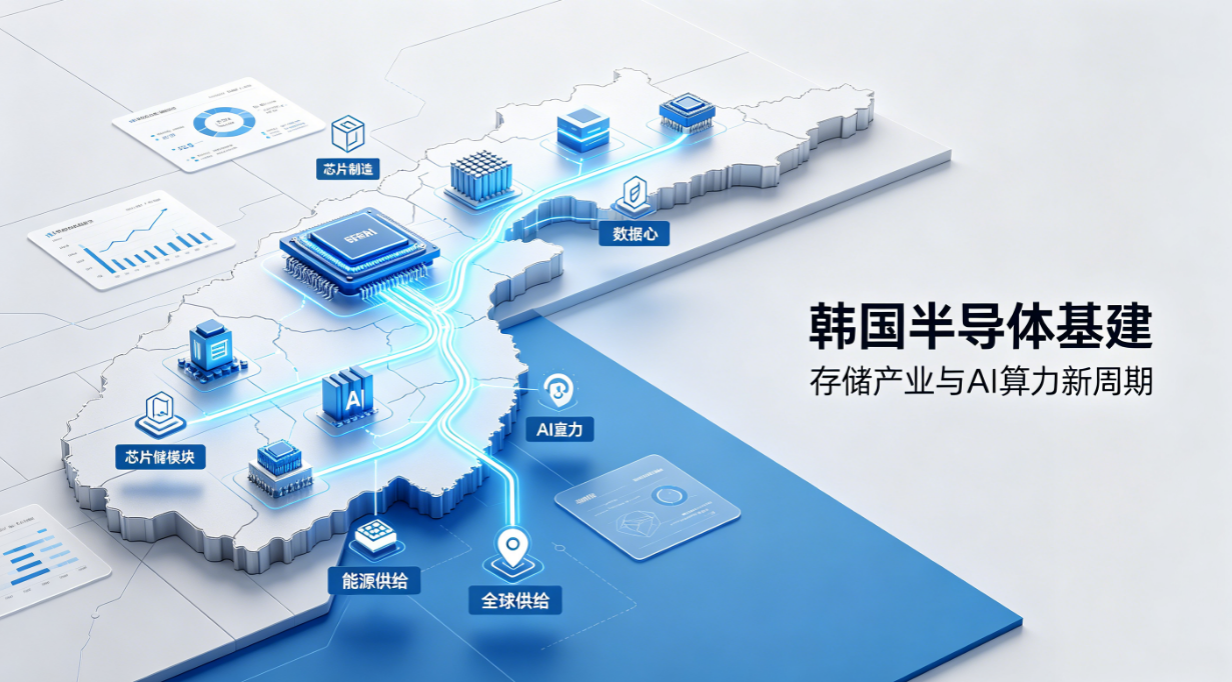
This article analyzes the 1,800-trillion-won AI infrastructure investment plan jointly launched by the South Korean government and industrial giants. Covering three mega-projects including memory semiconductors, physical AI and AI data centers, it demonstrates South Korea’s strategic layout and resolve to transform from a traditional memory chip leader into a powerhouse of AI computing capacity.
South Korea’s Large-Scale AI Infrastructure Drive: A Strategic Roadmap from Memory Champion to AI Computing Powerhouse
Introduction
Amid the cutthroat global AI competition, the South Korean government has partnered with domestic industrial giants to roll out an unprecedented investment program for AI infrastructure. On June 29, 2024, South Korean President Lee Jae-myung chaired a national briefing on three mega-projects at the Blue House, announcing investments exceeding 1,800 trillion won (approximately 7.92 trillion RMB) to build an industrial ecosystem centered on memory semiconductors, physical AI, and AI data centers. This ambitious initiative not only lays bare South Korea’s strategic ambitions within the global AI supply chain but also underscores its resolve to transform from a traditional memory leader into a powerhouse of AI computing capacity.
National Strategy: The Logic Behind the Three Flagship Mega-Projects
The core strategic logic of South Korea’s three mega-projects lies in fostering a virtuous cycle of “physical AI – data centers – industrial innovation.” President Lee Jae-myung explicitly stated that amid intensifying global AI rivalry, South Korea must adopt a “speed-first strategy” to seize industrial opportunities and expedite the construction of production hubs with overwhelming supply capacity.
For memory semiconductors, South Korea plans to inject roughly 800 trillion won (around 3.52 trillion RMB) into its southwestern region to build semiconductor manufacturing bases comprising four wafer fabs and supporting industrial clusters. Meanwhile, an advanced packaging hub with total investment of 81 trillion won will be established in the Chungcheong area. Notably, the South Korean government also plans to invest 550 trillion won (approximately 2.42 trillion RMB) in AI data centers, forming a complete industrial chain spanning chip manufacturing to computing output.
He Hui, Director of Semiconductor Research at Omdia China, analyzed that constrained by its limited economic scale, South Korea cannot build a full-fledged industrial chain. Instead, it chooses to make breakthroughs in its strength—memory chips. He vividly likened the strategy: “South Korea aims to build an ‘oil field’ for the AI era.” This strategic positioning precisely reflects South Korea’s core competitiveness in the global semiconductor division of labor.
Trillion-Won Ambitions of Industry Conglomerates
South Korea’s massive investment blueprint will ultimately be delivered by conglomerates including Samsung and SK Group, whose combined investment scale even surpasses the country’s total annual government budget of around 728 trillion won.
Samsung: Comprehensive Layout of the AI Ecosystem
Samsung Group announced plans to invest 2,655 trillion won (roughly 11.68 trillion RMB) in future industries, of which 2,030 trillion won will fund semiconductor industrial cluster development, and 625 trillion won will be allocated to AI semiconductors, robotics, batteries and other sectors. Samsung Group Chairman Lee Jae-yong stated that surging semiconductor demand driven by AI has prompted the group to push forward investments in the Yongin National Industrial Complex ahead of schedule and kick off planning for new semiconductor parks. He particularly emphasized that HBM (High Bandwidth Memory) sits at the heart of advanced packaging technologies and constitutes an indispensable product for AI training and inference.
SK Group: Building Infrastructure for the AI Era
SK Group has also unveiled staggering investment plans, announcing a 1,100-trillion-won semiconductor investment program and phased construction of nationwide AI data centers with a total capacity of 15GW. SK Hynix will complete the Yongin semiconductor cluster 12 years earlier than the original 2045 timeline to accelerate capacity expansion for DRAM and NAND chips. Choi Tae-won, Chairman of SK Group, clearly noted that the global memory chip market is already tight on supply, and demand will maintain rapid growth as AI applications keep expanding in the future.
Opportunities and Challenges from a Technical Perspective
Fundamental Shift in the Role of Memory Chips
Hsu Chia-yuan, Analyst at TrendForce, pointed out that DRAM is undergoing a fundamental transformation: evolving from highly standardized, interchangeable general components into strategic core hardware that determines the performance of AI systems, alongside HBM. This long-term trend will reshape the value of the memory industry for years to come. He further analyzed that Samsung and SK Hynix’s capacity expansion plans from 2026 to 2030 primarily target securing long-term orders from cloud vendors to expand market share of high-margin server DRAM and HBM products.
Milder Cyclical Volatility
As successive generations of HBM hit the market and demand expands, HBM will occupy an increasing share of wafer production capacity, creating structural supply constraints. Hsu explained that with a rising proportion of long-term orders, manufacturers will refrain from blind capacity expansion. Coupled with sustained global investment in AI infrastructure, the memory chip sector’s historic boom-bust cyclical swings are set to moderate markedly. TrendForce forecasts that since most new fabs will start mass production in late 2027 through 2028, the tight supply-demand balance for DRAM will persist before new capacity materially boosts supply.
Geopolitical Risks and Warnings
The scale of South Korea’s tech spending not only reflects its urgent desire to retain national leadership in AI chips but also bears profound implications for long-term national security. The UK’s Financial Times reported that U.S. President Donald Trump is pushing for semiconductor production reshoring to the United States, while Samsung and SK Hynix have begun constructing new computing facilities on U.S. soil. Against this backdrop, Lee Jae-myung is striving to safeguard South Korea’s technological edge.
Nevertheless, Professor Lee Jong-ho from the Department of Electrical and Computer Engineering at Seoul National University voiced prudent concerns over the execution of such large-scale projects: “Implementing initiatives of this magnitude requires extremely thorough planning. Sustained robust demand over the next 20 to 30 years would be the ideal scenario, yet no one can guarantee this with absolute certainty… A sharp downturn in demand would trigger severe repercussions.”
Morningstar analyst Jing Jie Yu also warned that these mega-projects risk triggering prolonged oversupply unless tech firms sustain heavy AI spending. He explained that new production capacity takes at least two to three years to come online. While demand will outpace supply in the early stage, peak capacity is likely to coincide with cooling demand in later phases, leading to excess supply.
Conclusion
South Korea’s launch of large-scale AI infrastructure development represents not merely a national industrial strategic upgrade, but also a high-stakes gamble shaping the landscape of the global AI supply chain. In its transition from a memory chip titan to an AI computing powerhouse, South Korea has demonstrated extraordinary determination and execution capacity. However, uncertainties stemming from technological innovation, complex geopolitics, and dynamic market supply-demand balance cast a shadow over this grand strategic blueprint.
Standing at a crossroads of technological evolution, South Korea has adopted an aggressive “gain first-mover advantage through speed” strategy. Successful execution would enable South Korea to retain an irreplaceable pivotal role in the AI era. Conversely, overexpansion-induced overcapacity risks could become hidden hurdles restraining its long-term growth. Regardless of the final outcome, South Korea’s massive AI infrastructure investment will serve as a critical reference case for the development trajectory of the global semiconductor and AI industries.

The content on this site is for learning and communication purposes only. It does not provide financial services such as account opening, capital allocation, discretionary trading, or insider trading. Do not trust any private messages recommending stocks or following orders within the site.