


Formal academic version Meta’s Computing Power Collaboration Strategy: A New Landscape of AI Infrastructure Forged Through Alliance Among Tech Giants
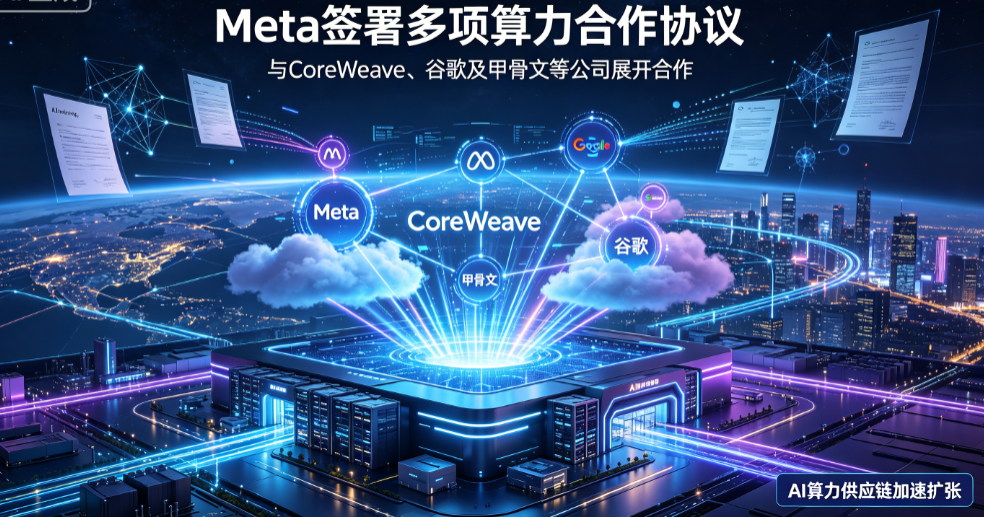
This paper conducts an in-depth analysis of Meta’s computing power cooperation strategy with CoreWeave, Google, Oracle and other enterprises, explores the backdrop of computing power demand in the era of large AI models, innovations in cooperation models and impacts on the industrial landscape, and reveals new trends in AI infrastructure amid collaboration among tech giants.
Meta’s Computing Power Collaboration Strategy: A New Landscape of AI Infrastructure Through Tech Giants’ Joint Efforts
Keywords
Meta, computing power partnership, CoreWeave, Google, Oracle, AI infrastructure, cloud computing, large language models, multi-cloud strategy
Introduction
Amid the rapid iterative evolution of artificial intelligence (AI), computing power has become a core resource driving technological innovation and commercial competition. As a global leader in social media and AI, Meta Platforms Inc. (hereafter referred to as Meta) has developed proprietary large language models (the LLaMA series) and multimodal AI applications, generating unprecedented demand for computing infrastructure. To date, Meta has signed multiple computing power cooperation agreements with partners including CoreWeave, Google Cloud and Oracle Cloud Infrastructure. This strategic layout not only reflects Meta’s long-term vision in the AI race but also establishes a new win-win collaborative paradigm within the global computing power ecosystem. Starting from Meta’s surging demand for computing resources, this paper conducts an in-depth analysis of its collaboration logic with each partner, innovations embedded in its cooperation models, and potential ripple effects across the industry landscape.
I. Background and Drivers of Computing Power Collaboration: From Self-Build to Joint Collaboration
1.1 The Computing Power Famine in the Era of Large AI Models
Meta identifies artificial intelligence as its top strategic priority for the next decade. Its flagship large language models such as LLaMA 2 and LLaMA 3 boast parameters ranging from tens of billions to over one hundred billion. Training a single model requires tens of thousands of top-tier GPUs (e.g., NVIDIA H100) as the baseline computing resource. Additionally, Meta’s core businesses including recommendation engines, advertising systems and content moderation heavily rely on real-time inference computing power. Industry estimates place Meta’s annual investment in AI computing power above the billion-dollar threshold, with spending still growing rapidly.
1.2 Limitations of Self-Built Data Centers
Meta has invested billions of dollars years ago to construct proprietary data centers across the United States, Denmark, Singapore and other regions. Nevertheless, the self-build model faces two critical constraints. First, the construction cycle spans several years from site selection and design to official launch, far too slow to match the breakneck iteration speed of AI models. Second, the model lacks flexibility: in times of seasonal or sudden spikes in training demand, in-house capacity cannot be expanded instantly. This bottleneck has pushed Meta to seek external computing power partnerships to complement its self-built infrastructure.
1.3 Strategic Value of Collaborative Partnerships
By partnering with diversified computing vendors including CoreWeave, Google and Oracle, Meta executes a decentralized multi-cloud, multi-supplier strategy. This approach eliminates over-reliance on a single cloud provider, leverages each vendor’s unique technical strengths to strike an optimal balance among cost, performance and reliability. Most crucially, long-term cooperation contracts lock in scarce GPU computing capacity for years to come, securing Meta’s competitiveness in the global AI arms race.
II. In-Depth Analysis of Partners: Specialized Roles and Complementary Advantages
2.1 CoreWeave: The Rise of a Niche GPU Cloud Provider
Originally a cryptocurrency mining firm, CoreWeave pivoted to deliver GPU cloud computing services. It maintains an exclusive deep partnership with NVIDIA, granting it priority access to cutting-edge GPUs and enabling bare-metal server offerings at lower price points than hyperscale cloud giants. For Meta, CoreWeave’s core strengths lie in its specialized GPU cluster management and elastic deployment capabilities. Reportedly valued at billions of US dollars, Meta’s contract with CoreWeave primarily supports training for next-generation large language models, and this landmark collaboration has propelled CoreWeave from a small startup to a pivotal player in the AI computing sector.
2.2 Google Cloud: An Ecosystem Partner for Deep Technical Integration
As one of the world’s top three hyperscale cloud providers, Google Cloud boasts a robust AI toolchain (including TensorFlow, TPUs and Vertex AI) and a global network infrastructure spanning all continents. Meta’s partnership with Google Cloud extends beyond simple computing resource rental to underlying technical synergy. For instance, Meta supplements GPU capacity with Google Cloud’s AI accelerator TPUs and leverages Google’s global data transmission network to optimize cross-regional training workloads. The two sides also explore joint development for open-source ecosystems such as PyTorch TPU support. This cooperation reduces Meta’s dependence on NVIDIA GPUs while boosting overall training efficiency.
2.3 Oracle Cloud Infrastructure: High Performance Coupled with Ultra-Low Latency
Oracle Cloud Infrastructure (OCI) dominates the enterprise cloud market with high-performance computing and low-latency networking, excelling at data-intensive workloads. Meta selects Oracle for its mature bare-metal servers, high-throughput storage systems and robust security compliance frameworks. OCI’s ultra-low latency architecture proves vital for Meta’s real-time AI inference tasks such as dynamic content recommendation. Furthermore, Oracle operates geographically independent data centers worldwide, helping Meta comply with local data sovereignty and regulatory requirements across jurisdictions.
2.4 Diverse and Complementary Cooperation Models
Meta’s partnerships with the three vendors are not transactional supplier relationships but differentiated frameworks tailored to distinct business scenarios. The CoreWeave agreement focuses on long-term GPU capacity reservations; the Google Cloud alliance centers on joint technical innovation and ecosystem integration; the Oracle collaboration targets optimization for latency-sensitive core workloads. This multi-layered collaboration network empowers Meta to dynamically balance computing costs, supply stability and technological innovation.
III. Innovations and Challenges of Collaboration Models: Operational Hurdles Under the Multi-Cloud Strategy
3.1 Technical Complexity Brought by Multi-Cloud Operations
Managing distributed computing resources across disparate cloud platforms poses massive operational challenges for Meta’s infrastructure teams. Each vendor features proprietary APIs, network topologies and monitoring tools, creating fragmentation in unified resource scheduling. Meta has built a proprietary cloud middleware layer that abstracts underlying vendor differences for upper-level AI training frameworks like PyTorch, while optimizing cross-cloud data transmission paths to cut latency. This requires heavy software engineering investment and deep technical alignment with every partner.
3.2 Cost Control and Contractual Risks
While long-term cooperation contracts lock in fixed pricing, the GPU market remains extremely volatile. A sharp future drop in computing power prices would leave Meta burdened with above-market contractual costs. Conversely, hardware supply crunches demand rigorous performance guarantee clauses. Hidden overheads such as cross-cloud data transfer fees and API invocation charges must also be factored into the total cost of ownership (TCO) assessment.
3.3 Data Security and Regulatory Compliance
Meta’s AI training pipelines process massive volumes of user data and confidential business information. Migrating such sensitive data to third-party cloud environments mandates strict encryption, access control and audit mechanisms. Meta requires all partners to obtain certifications including SOC 2 and ISO 27001, with clear data residency and permanent deletion clauses embedded in legal agreements. Oracle’s enterprise compliance expertise and Google Cloud’s data protection frameworks deliver critical safeguards for Meta’s data assets.
3.4 Balancing In-House Infrastructure and External Partnerships
Meta has not halted its self-built data center expansion amid external collaboration; instead, its proprietary capacity continues to scale. A dual-track model is emerging: self-built infrastructure handles baseline steady demand, while external cloud partners absorb volatile peak workloads. Dynamically orchestrating internal and external computing resources to eliminate idle capacity or resource shortages will be the linchpin of Meta’s operational efficiency.
IV. Industry-Wide Impacts: Reshaping the Global Computing Power Ecosystem
4.1 Fueling Growth of Specialized GPU Cloud Startups
Meta’s landmark partnership with CoreWeave sends a powerful market signal: even the largest tech conglomerates may turn to niche cloud vendors to satisfy specialized AI computing demands. This trend will spur the proliferation of GPU and AI training cloud startups, challenging the market dominance of the three hyperscale giants (AWS, Azure, GCP). CoreWeave’s successive large-scale financing rounds and global capacity expansion epitomize this market shift.
4.2 Driving Differentiated Competition Among Cloud Vendors
To secure mega-clients like Meta, cloud providers must pursue differentiated innovation across computing density, network performance and AI toolchains. Google Cloud ramped up TPU research and development, Oracle enhanced its bare-metal product lines, while Microsoft deepened its tie-up with OpenAI to attract enterprise customers. This intensifies technological iteration across the entire cloud industry, ultimately lowering barriers for small and medium-sized AI developers.
4.3 Strategic Implications for Industry Rivals
Meta’s comprehensive computing power collaboration framework creates competitive pressure for peers including Microsoft, Amazon and Apple. Competitors are forced to choose between developing proprietary AI accelerators (e.g., Google TPU, Amazon Trainium) or signing large-scale external computing partnership deals (e.g., Microsoft’s CoreWeave contract). Moving forward, AI computing power will remain the core battlefield of tech giants’ arms races, and the hybrid self-build-plus-collaboration model will likely become the industry standard.
4.4 Ripple Effects on NVIDIA’s Supply Chain
Meta’s massive long-term cooperation agreements essentially represent pre-order bulk purchases of NVIDIA GPUs, particularly the H100 and B200 series. While this exacerbates the existing GPU supply shortage, it also renders NVIDIA heavily reliant on a handful of top-tier enterprise clients. If major buyers like Meta shift toward self-developed chips or alternative accelerator vendors in the long run, NVIDIA’s market leadership will face mounting threats. In the short term, however, NVIDIA remains the primary beneficiary of this industry boom.
Conclusion
Meta’s computing power partnerships with CoreWeave, Google and Oracle constitute a critical moat-building strategy for its AI infrastructure roadmap. This multi-layered, multi-supplier collaboration model effectively resolves bottlenecks of Meta’s self-built computing capacity, boosts flexibility for model training and inference, and delivers a replicable win-win cooperation template for the broader tech industry. As AI models scale exponentially, the supply-demand imbalance for advanced computing power will only intensify. Meta’s experience proves that no single enterprise can fully meet all computing needs relying solely on self-built infrastructure or a solitary partner. Only by adopting an open, sophisticated strategy to build a diversified, dynamic computing power ecosystem can firms sustain competitiveness amid sweeping technological disruption.
Future Outlook
The hybrid “self-build + external collaboration” model pioneered by Meta will become commonplace across the tech sector. Competition over AI infrastructure will evolve beyond a simple race for hardware scale into an all-round contest of ecosystem integration, supply chain management efficiency and technological innovation speed. Meta’s strategic move not only determines the success of its internal AI roadmap but will also profoundly shape the trajectory of global cloud computing and artificial intelligence over the next decade.

The content on this site is for learning and communication purposes only. It does not provide financial services such as account opening, capital allocation, discretionary trading, or insider trading. Do not trust any private messages recommending stocks or following orders within the site.