


Intercontinental Shipping Invests USD 39.2 Million to Acquire Two IMO Tier III Chemical Tankers, Boosting Its ASEAN Fine Chemical Ocean Shipping Business
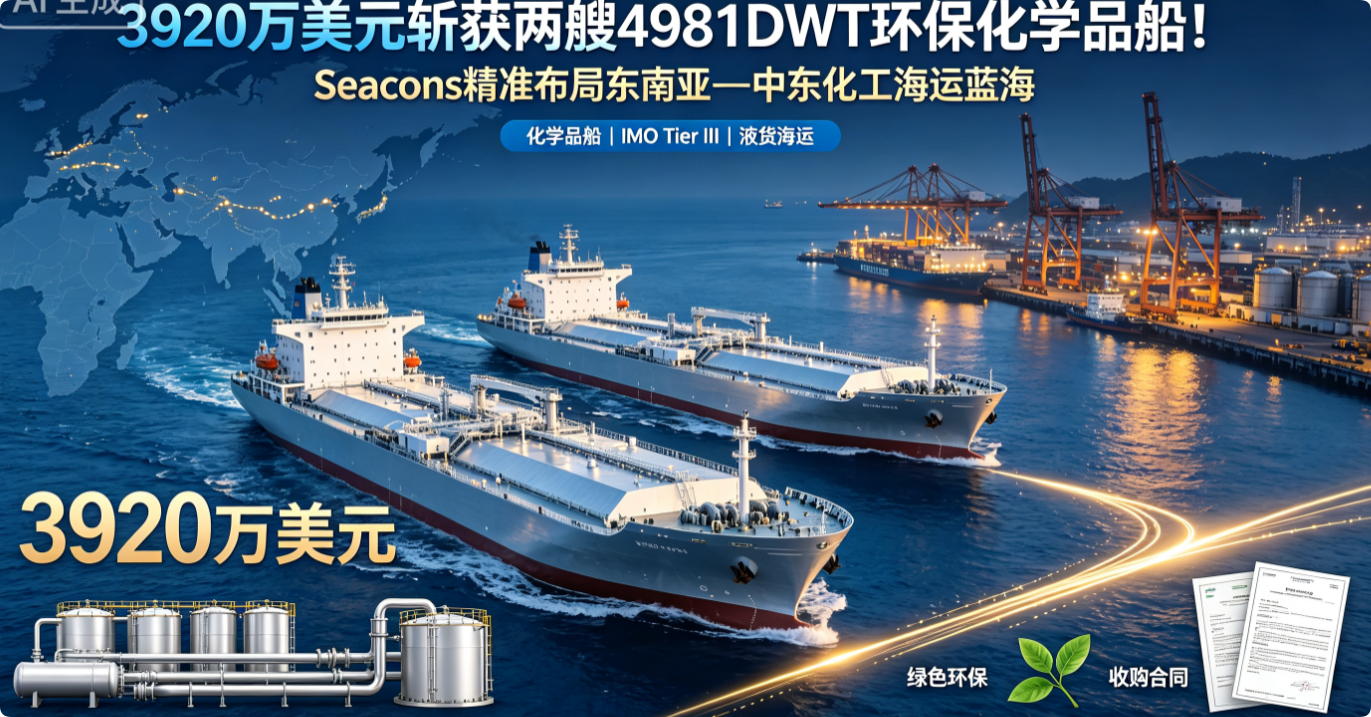
Through its wholly-owned Singapore subsidiary, Intercontinental Shipping acquired two newly-built 4,981 DWT stainless steel chemical tankers constructed in 2026 at a favorable total price of USD 39.2 million. Compliant with IMO’s strictest environmental emission standards, the vessels will operate on core routes connecting Southeast Asia and the Middle East to complete the company’s specialized liquid cargo transportation capacity.
English Translation (Formal Hong Kong Stock Exchange Announcement Style)
June 28, 2026 – Seacon Shipping (02409.HK), a shipping enterprise listed on the Hong Kong Stock Exchange, issued a major vessel acquisition announcement. Its wholly-owned Singapore subsidiary signed an agreement with a local shipping firm to purchase two newly-built 4,981 DWT stainless steel chemical tankers at a total consideration of USD 39.2 million. Named Golden Gerbera and Golden Osmanthus, both eco-friendly newbuilds were completed and delivered by domestic shipyards in 2026. This transaction marks a key strategic move for the Group to ramp up its specialized liquid cargo shipping business.
In terms of cost efficiency, maritime valuation agency VesselsValue pegs the fair market value of each vessel at USD 22.29 million, yet the Group secured each ship for only USD 19.6 million, representing a discount of up to USD 2.7 million per unit. Amid the industry-wide surge in newbuilding costs, this deal effectively curtails capital expansion expenditure while expanding high-quality tonnage at a competitive price. Concurrently, the Group raised over USD 26.1 million via the disposal of three ageing bulk carriers. By phasing out outdated, low-efficiency tonnage and adding new low-carbon specialized vessels, it continuously optimizes its fleet mix, cuts average vessel age, and strengthens compliance-driven operational competitiveness.
Both chemical tankers are constructed to meet the IMO Tier III, the world’s most stringent international environmental standards. Fitted with an inert gas protection system, high-efficiency vapour recovery units, and a full suite of marine wastewater pre-treatment facilities, they enable safe carriage of hazardous liquid cargoes including Category II and III industrial solvents, lubricants, vegetable oils, and chemical intermediates. The vessels can smoothly pass maritime inspections at environmentally stringent ports across Southeast Asia such as Singapore, Vietnam, Malaysia and Thailand, and qualify for policy incentives including priority berthing for low-carbon vessels and terminal charge rebates.
Regarding tonnage deployment, the two new tankers will primarily operate two core liquid cargo trade lanes: Southeast Asia ↔ Middle East and Southeast Asia ↔ Northeast Asia. Multiple petrochemical industrial parks in Vietnam, Indonesia and Malaysia have commenced mass production, fuelling rising regional import demand for methanol and basic chemical feedstocks. As the world’s key exporter of chemical raw materials, the Middle East sees year-on-year growth in two-way chemical trade with ASEAN, leaving specialized stainless steel chemical tankers in persistent tight supply-demand balance. Leveraging Singapore’s strengths as an international petrochemical transshipment hub, the new vessels will capture two-way cargo volumes: raw feedstocks shipped south from the Middle East and refined finished goods exported out of Southeast Asia, filling the Group’s business gap in high-end fine chemical marine transportation.
With the full implementation of global maritime regulations including the CII Carbon Intensity Rating, EU Carbon Border Adjustment Mechanism and EEXI Existing Ship Energy Efficiency Index, ageing high-emission vessels face multiple operational headwinds such as restricted route access and hefty fines. The Group consistently advances its green fleet strategy, managing a portfolio of over 40 owned and third-party vessels spanning four tonnage segments: dry bulk, product tankers, chemical tankers, and dual-fuel new energy ships, with trade routes covering major economic zones across Southeast Asia, the Middle East, Australia, Europe and the Americas. Industry analysts note that the RCEP dividend drives continuous expansion of Southeast Asia’s petrochemical industrial chain, supporting long-term growth prospects for eco-friendly specialized chemical shipping. This tonnage deployment will further consolidate Seacon Shipping’s differentiated competitive edge in ASEAN’s specialty shipping segment.

The content on this site is for learning and communication purposes only. It does not provide financial services such as account opening, capital allocation, discretionary trading, or insider trading. Do not trust any private messages recommending stocks or following orders within the site.