


Seacons Invests US$39.2 Million to Acquire Two 4,981 DWT Chemical Tankers, Bolstering Its Offshore Liquid Chemical Shipping Business in Southeast Asia
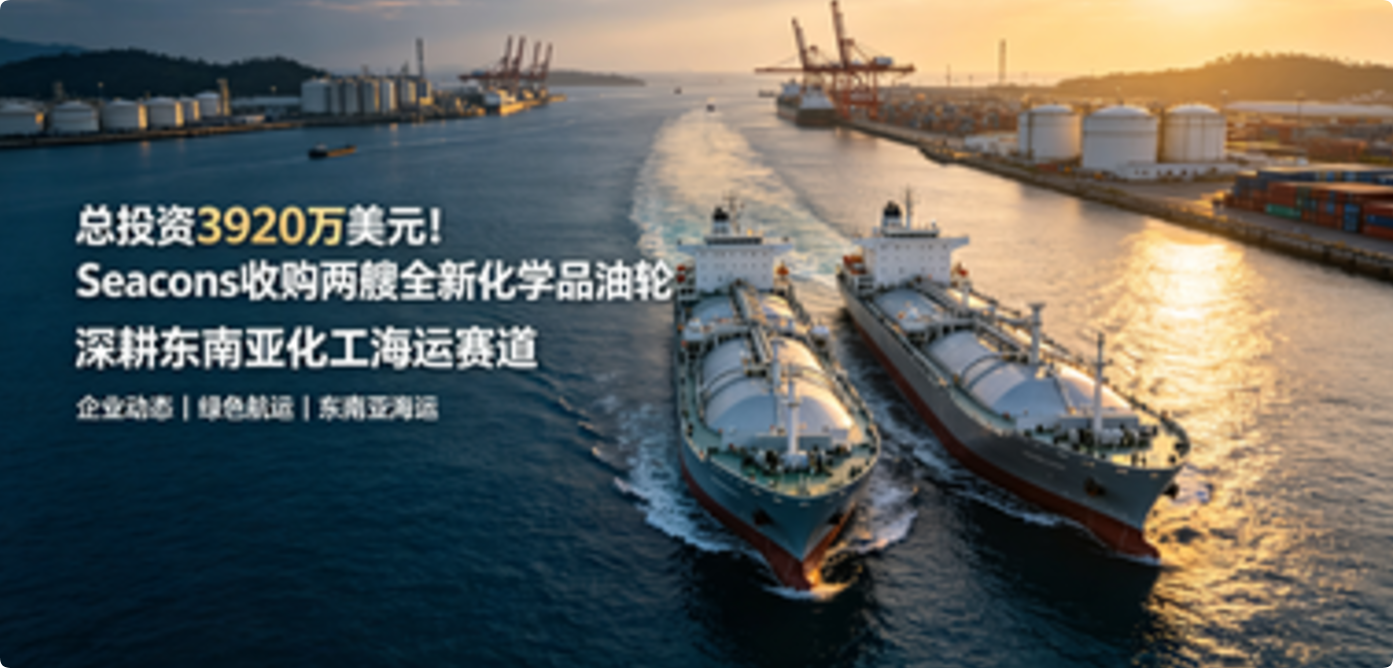
Seacons Marine has acquired two stainless steel chemical tankers newly built in 2026 for a total of US$39.2 million. This deal further upgrades its fleet toward specialization and decarbonization. Leveraging Singapore’s transshipment hub, the company will launch chemical shipping routes connecting Southeast Asia and the Middle East to complete its layout of liquid cargo transportation business.
English Translation
Seacons Marine Acquires Two New-Built Stainless Steel Chemical Tankers for US$39.2 Million to Specialize and Decarbonize Its Fleet
Seacons Marine has purchased two stainless steel chemical tankers newly constructed in 2026 at a total consideration of US$39.2 million, advancing its fleet upgrade toward specialization and green operations. Leveraging Singapore’s transshipment hub, the company will launch chemical shipping routes connecting Southeast Asia and the Middle East to complete its liquid cargo transport layout.
Recently, Hong Kong-listed shipping firm Seacons Marine Group issued a vessel acquisition announcement. Its wholly-owned subsidiary sealed a deal with a Singapore-based shipping company to acquire two brand-new 4,981 DWT stainless steel chemical tankers completed this year for a total investment of US$39.2 million, named MV Golden Gerbera and MV Golden Osmanthus respectively. This acquisition marks Seacons’ formal completion of its specialty liquid cargo transport segment. With its young, eco-friendly fleet, the group will deepen its footprint in cross-border ocean shipping for fine chemical raw materials between Southeast Asia and the Middle East.
Both chemical tankers are built to meet the highest Tier III environmental emission standards set by the International Maritime Organization (IMO). Equipped with inert gas protection systems, vapor recovery units and wastewater pre-treatment facilities, the vessels can safely carry a wide range of liquid cargoes including Class II and III industrial solvents, lubricants, vegetable oils and chemical feedstocks. They fully comply with stringent maritime environmental inspections at major Southeast Asian ports in Singapore, Malaysia, Vietnam, Thailand and beyond. Compared with prevailing prices in the secondhand vessel market, the unit price of this transaction delivers notable cost advantages, enabling rapid expansion of specialized capacity while keeping capital expenditure under control.
Seacons has long focused on ocean transportation of dry bulk and refined oil products, serving commodity trade across Southeast Asia, Australia and the Middle East via a comprehensive route network. Driven by the continuous expansion of Southeast Asia’s petrochemical industry, chemical industrial parks have opened in clusters across Vietnam, Indonesia and Malaysia, pushing up import and export demand for liquid chemical raw materials in the region and creating a persistent shortage of specialized chemical tanker capacity. Upon delivery, the two new tankers will primarily operate routes linking Southeast Asia with the Middle East, as well as Northeast Asia and Southeast Asia. Capitalizing on Singapore’s position as a world-class petrochemical transshipment port, Seacons will secure cross-border shipping orders for regional chemical products and foster a new growth driver for its business.
Amid the global low-carbon transition in shipping, policies including the EU Carbon Border Adjustment Mechanism, the International Maritime Organization’s CII Carbon Intensity Rating and global shipping carbon taxes have come into force one after another, driving up compliance costs for ageing, high-emission vessels. Seacons has consistently implemented a fleet renewal strategy phasing out old tonnage in favour of eco-friendly newbuilds. The two low-emission chemical tankers acquired will not only help the company avoid carbon-related penalties, but also qualify for low-carbon shipping incentives offered by ports across trade lanes, substantially cutting voyage operating costs.
To date, Seacons owns and manages more than 40 vessels under its custody, covering four categories: dry bulk carriers, product tankers, chemical tankers and dual-fuel new energy ships. Its shipping routes span core global trade zones including Southeast Asia, the Middle East, Australia, Europe and the Americas. Supported by its large-scale fleet and sophisticated vessel management expertise, the group provides one-stop shipping solutions for chemical traders and shipowners worldwide, covering cargo carriage, crewing management, maritime compliance and carbon emission optimization.
Maritime industry analysts noted that Southeast Asia’s petrochemical industrial chain is undergoing accelerated agglomeration, which will sustain steady long-term growth in regional chemical shipping demand. The addition of the two eco-friendly chemical tankers further strengthens Seacons’ differentiated competitiveness in niche Southeast Asian shipping segments. Going forward, the company will continue to optimize its fleet mix and expand its liquid cargo transport portfolio, consolidating its market standing amid the green transformation of global shipping and facilitating high-quality cross-border chemical trade in Southeast Asia.

The content on this site is for learning and communication purposes only. It does not provide financial services such as account opening, capital allocation, discretionary trading, or insider trading. Do not trust any private messages recommending stocks or following orders within the site.