


Zhipu GLM-5.2 Officially Open-Sourced, Topping Global Rankings with Million-Token Long Context and Full Compatibility with Domestic Computing Hardware
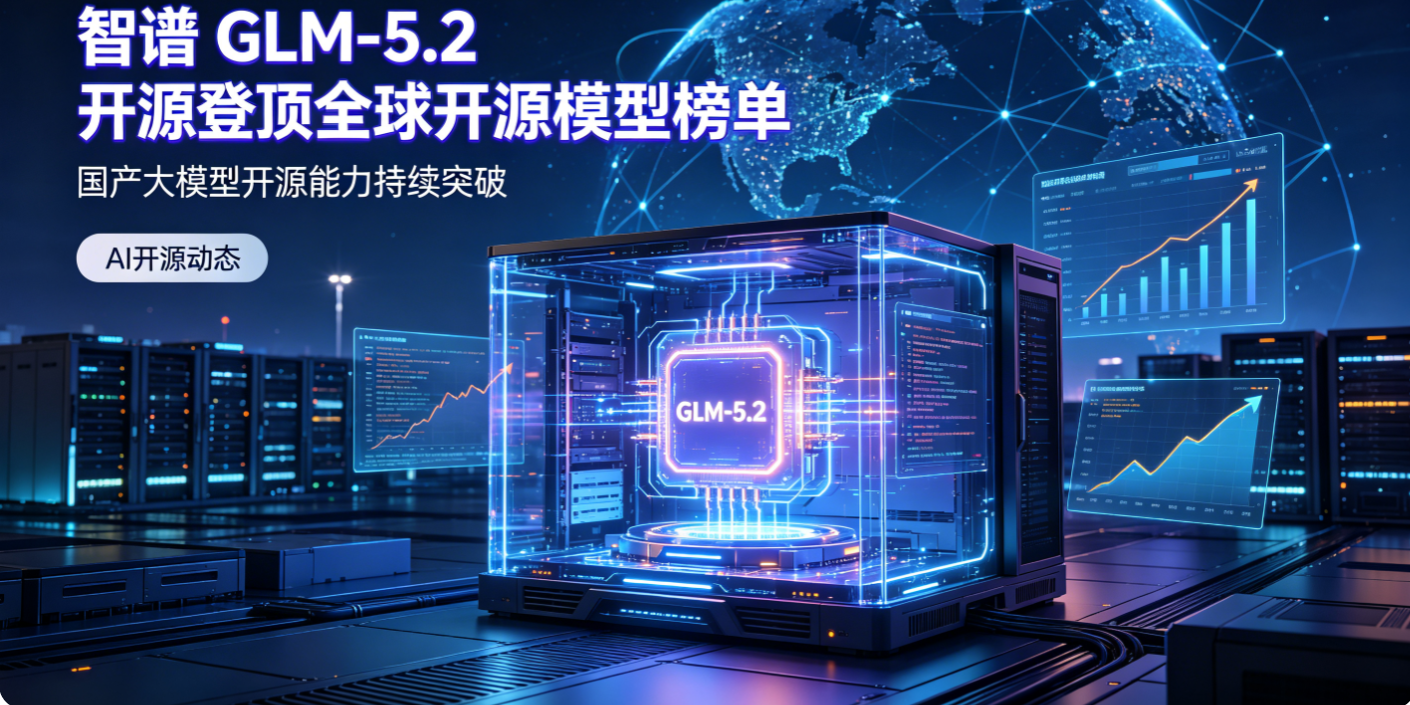
Zhipu AI released and open-sourced GLM-5.2, its new-generation flagship large model, which tops the global open-source model ranking on Artificial Analysis. The model delivers a production-ready million-token context window and greatly upgraded long-sequence coding capabilities, enabling end-to-end delivery of complex million-token projects in a single run. In addition
SSE STAR Market Daily, June 17 (Reporter Li Mingming)
On June 17, Zhipu AI (Z.ai) released and open-sourced GLM-5.2, its new-generation flagship large language model.
GLM-5.2 scored 51 points on the Artificial Analysis overall leaderboard, ranking as the state-of-the-art (SOTA) open-source model.
A Zhipu AI representative told reporters from SSE STAR Market Daily that this is the company’s most capable open-source model to date, built around two core breakthroughs: turning the theoretical 1 million-token context window into a production-ready feature, and further advancing long-horizon coding capabilities.
Reporters from SSE STAR Market Daily conducted hours of continuous real-world testing on GLM-5.2 Max, covering scenarios including long-context retrieval and generation, long-horizon Agent coding, and end-to-end delivery of complex industry research reports consuming nearly one million tokens in a single run.
Real-World Testing of GLM-5.2
According to Zhipu AI, the core innovation of GLM-5.2 lies in engineering a viable million-token context window.
For instance, the model can process over 880,000 tokens in a single continuous task, autonomously completing the full software delivery lifecycle from development, joint debugging and testing to packaging and launch. It can generate a complete application covering web, mobile and mini-program terminals within hours—work that previously required a team to collaborate for weeks.
Many models on the market claim million-token context support, yet a widely known industry issue is that most begin losing critical information after 300,000 tokens, with reasoning quality plummeting sharply for long texts. Zhipu’s technical solution combines multiple attention structure innovations: KV8 quantization, LayerSplit, IndexShare 4 and HiSparse sparse attention mechanisms.
From an engineering perspective, these optimizations target two clear goals: mitigating performance degradation and cutting inference costs at the full 1M token context length. Zhipu’s official data shows that at 1M context length, per-token FLOPs are reduced to 2.9× baseline levels, representing a roughly 66% drop in computational overhead compared with traditional architectures.
Zhipu disclosed a real test result in its technical blog: the model independently delivered a full-stack application supporting web, mobile and mini-program interfaces while processing 880,000 tokens, nearly maxing out the 1M context window. This proves the model retains full project state throughout ultra-long engineering workflows, rather than forgetting constraints defined in the third dialogue after ten rounds of conversation.
Reporters also put GLM-5.2 through hands-on testing. The task required the model to conduct in-depth competitive research on K12 online coding education products based on massive public materials, analyzing 15 mainstream brands across four core dimensions: curriculum, teaching faculty, pricing and parent feedback. It was tasked with delivering a full suite of outputs including an indexed XLSX database, a 20-page PDF analysis report, six comparative visualization charts, and reusable data processing scripts.
After roughly 30 minutes, the model fully retained 804 parent reviews and produced standardized Excel files with 12 data tables, a complete industry report, and runnable scripts. No common flaws of long-text models emerged, such as brand misidentification, missing data dimensions or inconsistent statistical metrics. That said, further optimization remains necessary for extreme 1M-token workloads.
To further validate the model’s deep analytical research capabilities, reporters issued another test prompt: based on publicly verifiable macroeconomic data from the National Bureau of Statistics of China, conduct systematic research on consumption upgrading across Chinese counties from 2018 to 2024, build a traceable database covering over 200 counties, and deliver raw data tables, research reports, presentation slides and supporting visualization charts.
Testing revealed GLM-5.2 Max can ingest nearly one million macroeconomic statistical materials in a single session, autonomously completing the full workflow of building quantitative databases for more than 400 nationwide counties, generating in-depth analysis reports and producing a full set of visual charts. It is fully suited for long-cycle big-data research tasks at financial consulting standards.
Positioning GLM-5.2’s Coding Capabilities Against Global Top-Tier Models
Zhang Youyu, Secretary-General of the AI Special Committee of the Beijing Computer Society and Distinguished Research Fellow at Peking University, told SSE STAR Market Daily that the launch of Zhipu GLM-5.2 marks a critical breakthrough for domestic models in coding-specific scenarios.
First, it breaks the global duopoly. Boasting top rankings on global coding benchmarks and strong cost performance, GLM-5.2 holds prominent advantages in long-context coding workloads. It is reshaping the industry landscape and forming a new tripartite competitive landscape dubbed the "New Three Giants" alongside Zhipu AI, OpenAI and Anthropic.
Second, while it does not outperform leading overseas models across all dimensions, it serves as a fully viable alternative for most mid-to-high-frequency real-world development scenarios. "However, core shortcomings persist: GLM-5.2 still faces a noticeable technical gap versus the world’s most advanced models in deep mathematical logical reasoning and complex cross-domain knowledge integration—this will be the key focus for future R&D," Zhang added.
Day-0 Compatibility with Domestic Computing Infrastructure
Beyond performance, GLM-5.2 is released under the permissive MIT License, permitting free commercial use. Neither its training nor online inference relies on overseas computing hardware.
On its launch day, GLM-5.2 completed Day-0 inference compatibility with eight major domestic computing platforms. This combination of an open-source domestic large model and domestic computing hardware has drawn widespread industry attention.
Zhipu AI also told reporters that the upcoming Ascend 950 super node, slated for launch in the second half of the year, will serve as a core computing foundation for GLM-5.2.
"Day-0 compatibility" does not merely mean the model can run on domestic chips; it signifies full-depth inference adaptation and operator-level optimization completed on release day. This positions domestic chips as first-tier infrastructure on par with overseas computing platforms, rather than a backup alternative.
Zhipu’s compatibility list covers leading domestic computing hardware vendors: Huawei Ascend, Cambricon, Moore Threads, Hygon, Biren Technology, Muxi, Kunlunxin and T-Head. This multi-vendor support diversifies supply chain risks and maximizes coverage of localization replacement demands across various industries.
From a commercial perspective, GPU procurement and leasing currently account for the bulk of computing costs for domestic large model developers, with heavy reliance on high-end overseas chips such as NVIDIA H100/H200. Amid escalating U.S.-China tech competition, self-sufficient and controllable computing supply chains have evolved from a strategic reserve to an operational necessity for survival.
For developers, native compatibility with domestic hardware delivers two key benefits: first, enterprise users can deploy GLM-5.2 privately within fully domestic environments to satisfy data security and compliance requirements; second, mature domestic alternative solutions stand ready to mitigate disruptions to overseas computing supply, eliminating the need for ground-up adaptation work.
Technically, enabling inference compatibility across multiple domestically developed chips with vastly different architectures demands extensive engineering tuning for operator compatibility, memory management and inference efficiency. Zhipu’s ability to deliver synchronized Day-0 adaptation demonstrates deep in-house expertise in heterogeneous computing within its underlying engineering team.

The content on this site is for learning and communication purposes only. It does not provide financial services such as account opening, capital allocation, discretionary trading, or insider trading. Do not trust any private messages recommending stocks or following orders within the site.