


South Korea's Major AI Infrastructure Buildout Officially Kicks Off: Ambitions and Challenges Behind Massive Investment
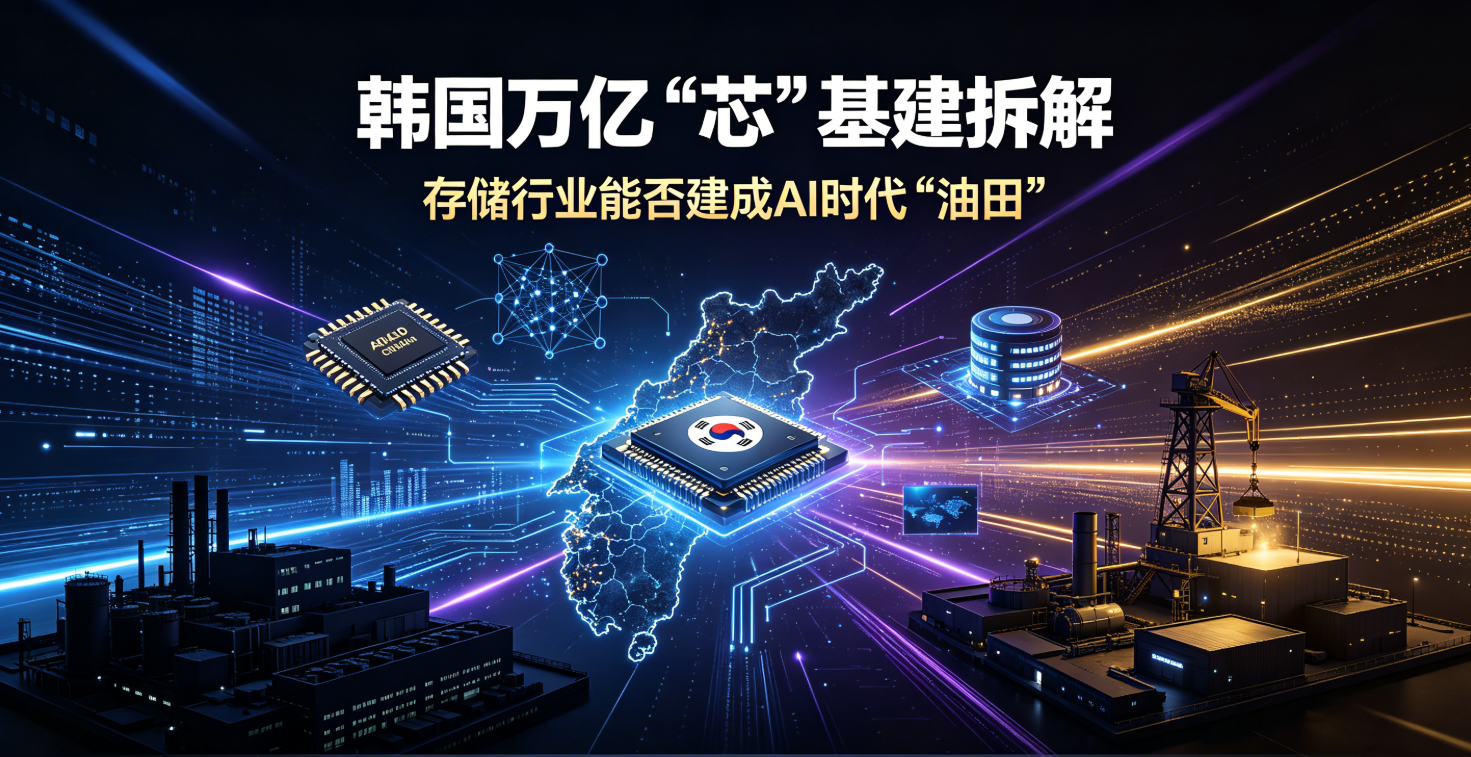
South Korea's AI Infrastructure Mega-Buildout Officially Launches: Ambitions and Challenges Behind Massive Investment
Introduction
As global artificial intelligence (AI) competition intensifies, the South Korean government and domestic tech giants have joined forces to launch an unprecedented “AI infrastructure mega-buildout.” On June 29, 2024, South Korean President Lee Jae-myung presided over the “National Report Session on the Three Super Projects” at the Blue House, announcing total investment of more than 1,800 trillion won (about RMB 7.92 trillion). The plan focuses on three areas: memory semiconductors, physical AI, and AI data centers. It shows South Korea's determination to become an “irreplaceable” industrial powerhouse, while also revealing its key role and potential risks in the global AI supply chain.
The Three Super Projects: From Semiconductors to AI Infrastructure
The government's three super projects target semiconductor manufacturing, physical AI applications, and AI data center construction. In memory semiconductors, Lee stressed that to meet surging global chip demand, South Korea must speed up production hub construction. In particular, large-scale investment in the southwest region will help build production bases with overwhelming supply capacity in advance. About 800 trillion won (about RMB 3.52 trillion) is expected to go into the region, where four fabs and related industrial clusters will be built to make a new semiconductor hub for South Korea.
In physical AI, the government plans to bring AI into manufacturing, promote more than 1,000 industry-specific robots each year, and use Hyundai Motor Group's investment as a springboard to build a robot contract manufacturing plant and a parts production park in the Saemangeum industrial complex in North Jeolla Province. President Lee also said AI data centers are the key node for forming a virtuous cycle of “physical AI-data center-industrial innovation.” As a result, the government plans to invest 550 trillion won (about RMB 2.42 trillion) in the Chungcheong region to build AI data centers with total capacity of 8.4 gigawatts (GW), and aims to invest more than 1,000 trillion won by 2035, expanding total capacity to 18.4 GW.
Samsung and SK's Trillion-Won Ambitions: A Giant-Led Investment Wave
South Korea's massive investment plan must ultimately be implemented by corporate giants such as Samsung Electronics and SK Hynix. Under the announced plan, Samsung Group will invest a total of 2,655 trillion won (about RMB 11.68 trillion) in future industries, including 2,030 trillion won (about RMB 8.93 trillion) for semiconductor cluster construction and 625 trillion won (about RMB 2.75 trillion) for AI semiconductors, robotics, batteries, and more. Samsung Chairman Lee Jae-yong said chip demand driven by AI is growing rapidly. The company has already advanced investment in the Yongin National Industrial Complex and is planning new fabs, with Gwangju among the candidate sites. Samsung will also focus on advanced memory and packaging technologies such as HBM (high-bandwidth memory), as well as infrastructure including AI data centers and digital twin factories.
SK Group said it will push ahead with a semiconductor investment plan totaling 1,100 trillion won (about RMB 4.84 trillion) and build 15 GW of AI data centers across the country in phases. SK Hynix will bring forward by 12 years the construction of the Yongin semiconductor cluster, originally due in 2045, and plans to build a new semiconductor cluster in the southwest region with total investment of about 400 trillion won. SK Group Chairman Chey Tae-won said the global memory chip market is already tight, and demand will keep growing rapidly as AI applications expand, so the company will steadily advance related investments.
Opportunities and Hidden Risks in a Global Race
The scale of this AI infrastructure buildout underscores South Korea's urgent goal: to maintain its leading position in AI chips and secure long-term national security. He Hui, semiconductor research director for Greater China at Omdia, noted that South Korea is a relatively small economy and cannot have a full industrial chain, so it has chosen to focus on its strength—memory, trying to turn it into the “oil field” of the AI era. TrendForce analyst Xu Jiayuan said the future expansion plans of Samsung and SK Hynix are mainly aimed at securing long-term orders from cloud service providers and expanding share in the high-margin server DRAM and HBM markets. He believes DRAM is shifting from a standardized commodity component to a strategic core that affects AI system performance, and this will be a long-term trend reshaping memory industry value.
However, this ambitious plan also carries significant risks. Morningstar analyst Jing Jie Yu warned that these super projects could lead to long-term oversupply unless tech companies keep increasing AI investment. He said new capacity would take at least two to three years to come online; demand would likely exceed supply at first, but once peak capacity is up, demand may cool. Lee Jong-ho, a professor in the Department of Electrical and Computer Engineering at Seoul National University, also noted that building cutting-edge fabs requires massive power and water resources, advanced logistics, deep supplier networks, and highly skilled labor, which may not be available quickly in new regions. He fears the consequences could be severe if demand over the next 20 to 30 years falls short of expectations.
Conclusion: Both Promise and Risk
South Korea's AI infrastructure mega-buildout is undoubtedly a high-stakes bet in the global AI race. It highlights South Korea's technical edge in memory semiconductors and its active positioning in AI data centers and physical AI applications. In the short term, the investment will boost the domestic semiconductor supply chain and bring new order opportunities to giants like Samsung and SK. In the long run, however, demand volatility, mismatched construction cycles, and geopolitical influences could all become traps for this grand plan. Whether South Korea can turn a “speed strategy” into a sustainable competitive advantage will depend on its ability to precisely manage the pace of capacity expansion and ensure supporting infrastructure is in place. This AI infrastructure buildout, jointly driven by the state and enterprises, is both an opportunity and a challenge, and its final outcome will profoundly affect South Korea's position in the global semiconductor and AI industries.

The content on this site is for learning and communication purposes only. It does not provide financial services such as account opening, capital allocation, discretionary trading, or insider trading. Do not trust any private messages recommending stocks or following orders within the site.