


Gold and Silver Market Divergence: Reassessment and Outlook After Rebound
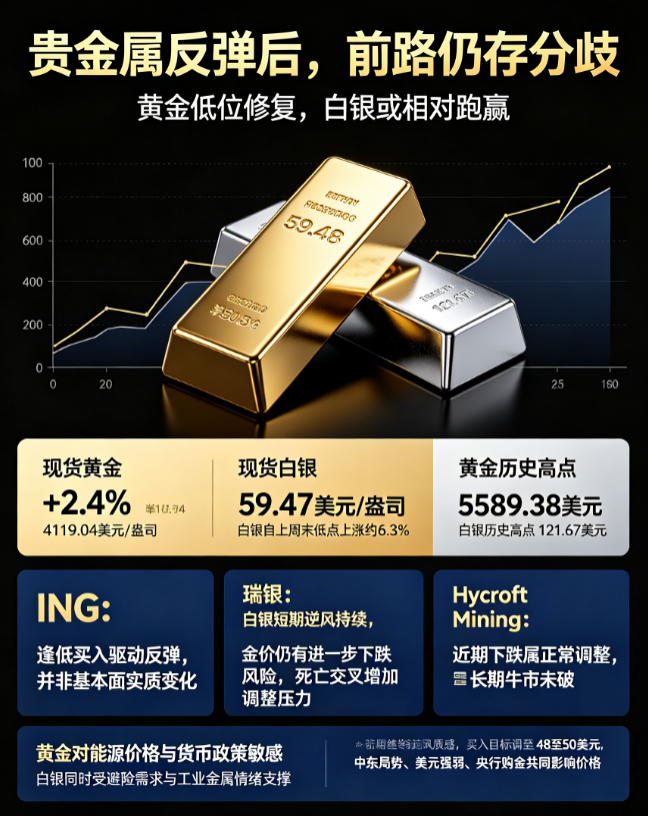
Gold and Silver Market Divergence: Reassessment and Future Outlook Behind the Rebound
After a period of sustained selling pressure, the precious metals market has finally seen a significant price rebound recently. In early trading on Wednesday, spot gold rose about 2.4% to $4,119.04 per ounce; meanwhile, spot silver was at $59.47 per ounce, up about 6.3% from $55.9 last weekend. This rebound has undoubtedly injected a boost into the market, but professional analysts remain cautious about whether these two precious metals can regain the record highs set earlier this year.
Drivers Behind the Rebound: Buy-on-Dip Rather Than Fundamental Shift
ING commodity strategists Warren Patterson and Ewa Manthey explicitly stated in a report released on Wednesday that the recent rise in gold and silver mainly stems from "buy-on-dip following recent price weakness" rather than "substantial changes in geopolitical or macroeconomic backgrounds." This view provides a rational footnote to market optimism.
In fact, despite a strong rally in gold and silver throughout 2025 and continuing into 2026, both prices are still far below the record highs set earlier this year. Specifically, both gold and silver reached their all-time highs at the end of January—spot gold once hit $5,589.38 per ounce, and silver climbed to $121.67 per ounce. From current prices, gold is still about 26% below its record high, while silver's gap is as high as about 51%.
Interest Rates and Strong Dollar: Dual Pressure on Precious Metals Upside
Analysts generally believe that high interest rates and a persistently strong U.S. dollar are two key factors undermining the appeal of precious metals. Additionally, rising oil prices due to the Middle East war have further altered capital flows and trading logic in other market areas. Patterson and Manthey said: "Although Middle East tensions still provide some support for precious metals, the market is weighing the relationship between weakening U.S. economic data and the inflation risks brought by rising energy costs."
In this complex macro environment, gold "may remain highly sensitive to changes in the energy market and expectations for U.S. monetary policy." This means that unless there is a clear signal of policy shift, gold's upside potential may remain capped.
Silver's Potential: Possibility of Outperforming Gold
In contrast to the pessimistic outlook for gold, analysts believe silver may have better performance prospects. Patterson and Manthey noted that if industrial metals continue to strengthen while safe-haven demand remains, silver "may continue to outperform gold." They further explained: "Silver's performance reflects not only its safe-haven attributes but also support from improved sentiment in industrial metals, especially driven by copper market performance."
Silver's dual nature—both a monetary metal and an industrial metal—gives it unique advantages in the current market environment. Especially driven by the AI revolution and supercomputer development, silver's industrial demand is growing continuously, and there is no substitute that can fully replace its function in the short term.
Gold Faces Death Cross and Technical Downside Risk
However, not all institutions are optimistic about silver's short-term outlook. Bank of America analysts believe that after posting its worst quarterly performance in 13 years in the three months ending June, gold prices still face further downside risk. In a report on July 16, Bank of America warned: "Death cross signals, high net long positions, and similarities to major top patterns increase the risk of a longer, deeper correction."
The so-called "death cross" is a technical analysis pattern where a stock's short-term moving average—typically the 50-day moving average—falls below its long-term moving average, usually the 200-day moving average. This technical signal is often seen as a strong warning of market weakness, and for gold investors, it is undoubtedly a risk warning that cannot be ignored.
UBS's Cautious Stance: Silver's Short-Term Headwinds Persist
Even for silver, which is considered to have more potential, UBS maintains a cautious stance. The Swiss bank lowered its attractive silver purchase price target from the previous ~$55/oz to the $48-50/oz range and reminded investors not to rush into building silver positions.
UBS strategist Dominic Schnider wrote in a report on July 20: "We believe the headwinds facing silver in the short term may persist, as escalating Middle East tensions, higher opportunity costs, and a strong U.S. dollar will continue to dampen investor sentiment." He added: "From a macro perspective, the backdrop for silver does not provide enough impetus for investors to add long positions. With unstable investment demand, silver prices have not found a solid bottom."
Mining Companies' View: Long-Term Outlook Remains Bright
In stark contrast to the cautious stance of institutional analysts, mining companies remain optimistic about the long-term prospects of gold and silver. Diane Garrett, Executive Chairman and CEO of Hycroft Mining, a U.S. gold and silver developer, said in an interview on Tuesday that the recent price decline in gold and silver is a "normal correction" and emphasized that "this is not a broken bull market."
She pointed out: "The fundamentals of the commodity market remain very strong, especially for gold, as it has surpassed U.S. Treasuries to become the largest asset class and is becoming the foundational infrastructure of the financial system." She added: "People don't want to hold hard assets backed by other countries' debt, and we have seen central banks continuously buying gold for 17 consecutive months. These figures are very compelling."
Regarding silver, Garrett was equally optimistic: "The same is true for silver, because it is not only a monetary metal but also an industrial metal. It is driving the AI revolution and supercomputer development—all these areas require silver, and there are no substitutes."
Conclusion: Long-Term Opportunities Amid Short-Term Volatility
Taking all views into account, the current precious metals market is in a complex phase of mixed bullish and bearish factors. In the short term, factors such as interest rate policy, dollar trends, geopolitical risks, and energy price fluctuations will continue to dominate the price movements of gold and silver. From a technical perspective, gold may face further correction pressure, while silver, although having the potential to outperform gold, still needs to break through multiple headwinds in the macro environment.
However, from a long-term perspective, central banks' continued accumulation of gold, silver's irreplaceable industrial demand, and the inherent safe-haven attributes of precious metals provide solid price support for both metals. For investors, the current market adjustment may be a good opportunity to reassess and build positions in quality assets, but patience is needed, waiting for clearer market signals to emerge.

The content on this site is for learning and communication purposes only. It does not provide financial services such as account opening, capital allocation, discretionary trading, or insider trading. Do not trust any private messages recommending stocks or following orders within the site.