


Gold Market Extremes: Central Bank Strategy and Volatility Analysis
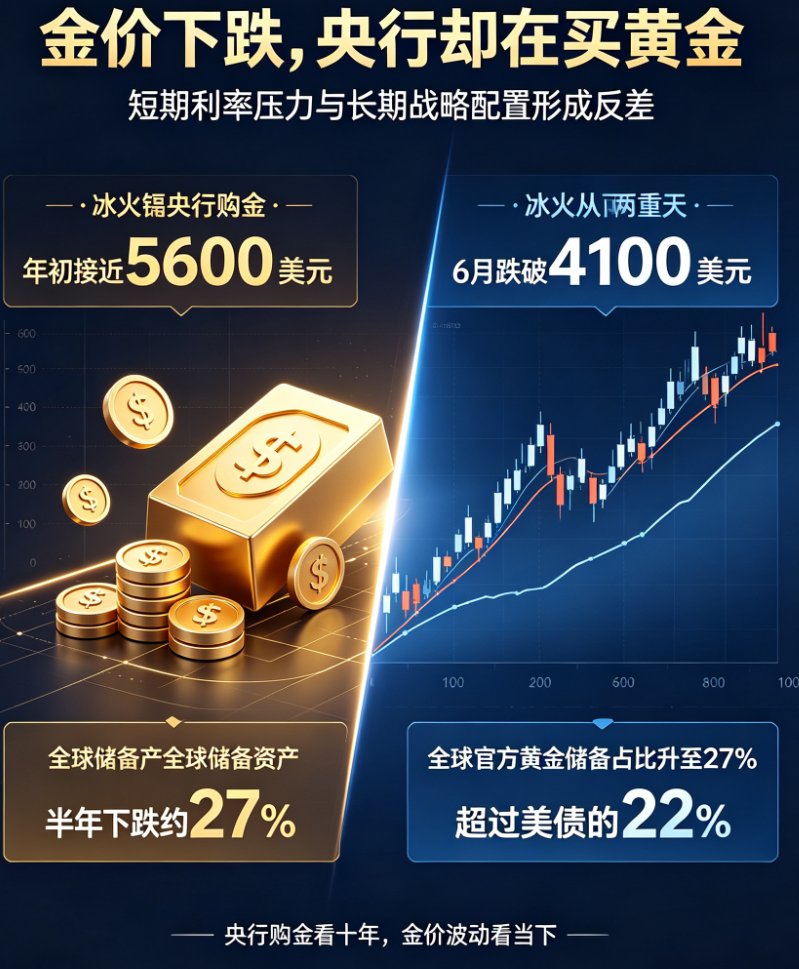
Gold Market Duality: Contradiction Between Central Bank Strategic Allocation and Short-Term Volatility
Introduction: The Logic Behind the Contradiction
Recently, the gold market has presented a puzzling extreme contrast that has confused many investors. On one hand, international gold prices have been declining since the beginning of the year, from a historic high near $5,600 per ounce in January 2026 to below $4,100 per ounce on June 11, a drop of nearly 27% in half a year. On the other hand, central banks have been bucking the trend by continuously increasing their gold reserves. According to the latest European Central Bank report, gold's share of global official reserves has risen to 27%, surpassing U.S. Treasury bonds at 22% to become the largest single asset in global official reserves. What logic lies behind this extreme contrast? This article will delve into the reasons.
1. Central Banks Buying Gold: Strategic Security and Risk Diversification
Central banks are increasing gold holdings because gold has an irreplaceable advantage: no sovereign credit risk. Simply put, gold has no default entity and no counterparty risk, making it the ultimate safe-haven asset. Against a backdrop of rising global economic uncertainty and heightened geopolitical tensions, central banks are reducing their holdings of dollar assets (such as U.S. Treasuries) and increasing gold allocations to diversify single-asset concentration and strengthen the stability of their reserves.
Since 2022, a global central bank gold buying spree has taken shape, with net purchases exceeding 1,000 tons for three consecutive years. This is not short-term market speculation but a long-term strategic security layout. Especially amid frequent geopolitical conflicts and potential disruptions to international payment systems, gold, as a globally recognized ultimate means of payment, has become a key ballast for countries facing payment uncertainty.
2. Drivers of Gold Price Decline: Short-Term Market Sentiment and Policy Expectations
However, the paradox is: if central banks are buying heavily, why are gold prices still falling? This results from multiple short-term factors.
First, profit-taking pressure exists. In 2024 and 2025, international gold prices surged sharply, accumulating large profits, and technical correction pressure naturally emerged.
Second, the Middle East situation has continuously pushed up energy prices, fueling inflation expectations. Markets then began to anticipate that the Fed might be forced to raise interest rates again to curb price pressures. This pushed up U.S. Treasury yields and strengthened the dollar index, directly capping the upside of dollar-denominated gold.
This creates a special situation: central banks buy gold against the trend for long-term strategic allocation, while short-term market prices are driven by interest rates, the dollar, and liquidity expectations, showing a completely different trajectory.

3. Typical Interaction Between Policy Expectations and Market Sentiment
The chart shows a clear decoupling between central bank gold purchases and short-term gold price fluctuations. Central banks focus on global financial security and risk diversification over the next five to ten years, while short-term price movements reflect current monetary policy direction and market sentiment. In other words, these two lines have not yet formed a resonance. This also explains why central bank and retail investor decision-making logic differs so sharply at the same time.
Conclusion: Rational Investing, Avoid Chasing Rallies or Panic Selling
Based on the above analysis, investors should understand that the gold market is currently in a phase of structural contradiction. Central banks' gold purchases are based on long-term strategic considerations, while short-term gold prices are constrained by inflation, interest rates, and dollar strength. Therefore, individual investors should avoid speculative trading. The market environment in 2026 differs significantly from 2024 and 2025; this year the focus must be on the negative impact of inflation stickiness and liquidity tightening on gold.
Finally, the author suggests readers control positions reasonably based on their own financial situations and risk tolerance, and view ups and downs rationally. Gold is a safe-haven asset but not a risk-free cash machine. Only by returning to the essence of asset allocation can investors stay calm amid market volatility and avoid the trap of chasing rallies and panic selling.

The content on this site is for learning and communication purposes only. It does not provide financial services such as account opening, capital allocation, discretionary trading, or insider trading. Do not trust any private messages recommending stocks or following orders within the site.